The Invisible Cost
How much does lost time cost businesses?
In business, time is not lost all at once. It is lost little by little.
Day after day, minute by minute, microscopic delays and operational interruptions accumulate into a significant business cost that no one tracks.
Five minutes of waiting here, ten minutes of delay there – at first glance, nothing to worry about. But when this becomes a daily pattern, an organization begins to lose productivity, leading to direct financial losses.
Time has a way of adding up. When these “insignificant” 5, 10 or 15 minutes are multiplied by the number of employees, working days and business meetings, the scale of the loss becomes alarming. Companies often feel the impact on their results but rarely ask themselves the key question: How much time do their people spend on secondary processes that could be organized more efficiently?
The problem goes beyond the minutes directly lost. When an employee is interrupted while working on a core task, they must stop what they are doing, respond to the new situation and then refocus on their work.
How much does distraction actually cost us?
Research into this question makes interruptions an interesting and important subject for science. A systematic meta-analysis published in the journal Applied Ergonomics examines numerous laboratory experiments and interventions related to the workplace. The authors find that the cost of an interruption does not end when the interruption itself stops. There is what researchers call resumption lag – the time a person needs to restore the context of a task and return to the interrupted activity.
In real business life, this means something very simple: small, everyday operational delays cost far more than the clock suggests.

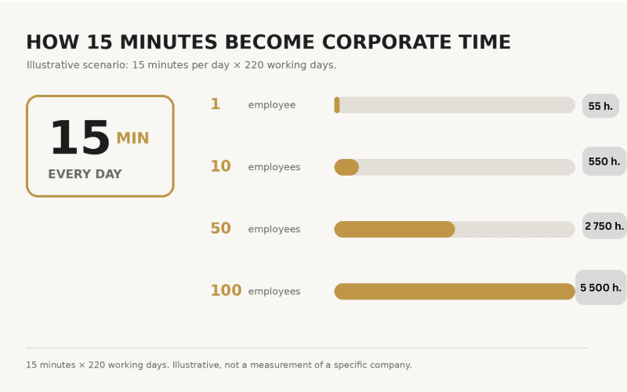
The Question Is No Longer Just “How Much Do 15 Minutes Cost?”
Research shows that the cost of interruptions cannot be measured by their duration alone. After an interruption, a person must re-establish the context of the task and return to the workflow.
A company does not necessarily need to own a resource for every possible situation. Sometimes, having access to the right resource precisely when it is needed matters more.
What Are Business Travellers Really Looking For?
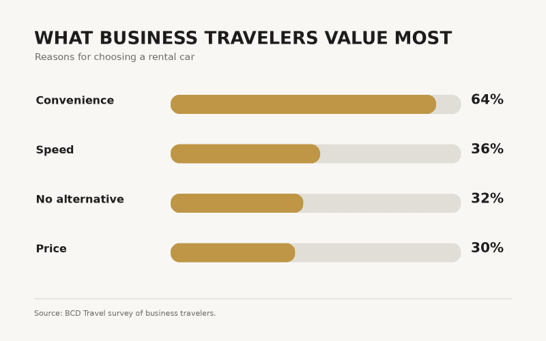
This is where the data becomes interesting. A BCD Travel survey of 919 business travellers from North America, Europe, the Middle East and Africa, all of whom had rented a car at least once in the previous 12 months, examines their behaviour and the factors influencing their choice of rental car. The survey was conducted in December 2023.
When choosing a rental car instead of another form of ground transportation, 64% cited convenience, 36% speed, 32% a lack of alternatives and 30% price.
These figures are interesting not so much because of the service itself, but because of what they reveal about people’s behaviour. Price matters, but it is not the only criterion.
When it comes to business travel, convenience and speed have value too.
The survey shows that convenience is among the leading priorities when choosing a rental car.
This is where the definition of modern corporate mobility begins to change. The data suggests that, for businesses, a car is more than just a means of transport. It is part of a broader approach to managing time more effectively, increasing flexibility and improving operational efficiency.
As the exclusive representative of global leaders Avis and Budget in Bulgaria, M Rent offers solutions designed around these needs. Partnering with M Rent reduces the administrative burden on your teams. Instead of spending valuable time managing a fleet, insurance policies and vehicle servicing, your employees gain access to flexible car rental solutions and operational leasing, backed by the international standards of the Avis and Budget brands.
In this way, M Rent helps turn off the tap from which your company’s precious time is slipping away.
This is where corporate mobility meets time management. Under the new corporate standard, a good company is not one that makes its people work more, but one that removes enough of the small obstacles that prevent them from using their time for what they do best.
Because five minutes do not seem like a problem.
Neither do ten minutes.
Fifteen seem even less significant.
Until we multiply them.
That is when we realize that productivity does not always begin with doing more.
Sometimes, it begins with stopping the loss of the time we already have.
Because in modern business, the most valuable resource may not be the one we see in the financial statements.
It may be the one that quietly slips away – between two tasks, between two meetings, between two hours in the calendar.
Source: M Rent EAD